Education is what remains after one has forgotten what one has learned in school (Albert Einstein). Primary schooling is all about learning for life. What’s more important to learn in life than planning and organization? And when it comes to our part of the world, the person who could be presented to children as one of the most successful planners and organizers is Aurangzaib Alamgir.
If good education is judged by the duration for which it is retained, then skills should be taught in schools. Skills remain with us long after we have forgotten the knowledge memorized. Knowledge evaporated over time while skills penetrated deep within us. Skills help us acquire knowledge throughout our life. But knowledge alone cannot help us develop skills, nor can it help us collect more information. The 34 life skills are sufficient for a healthy and productive life.
Meanwhile, social study is a good area to develop many of these crucial life skills. We can introduce children to individual life skills through short descriptions, examples, and stories. But there is a problem with doing that.
Most of the great Muslim personalities are not mentioned in the social studies syllabus with pride and respect. Their achievements are not highlighted, and their lifestyle is not described. The great people of our region are mentioned but just for the sake of information. They are often forgotten by the time of the final examination. They are not presented as people with all the life skills. Simply put: we don’t have any role models in our social studies books, just people from the past.
The skill to plan and organize is one of the most important skills to develop. Think of all the great leaders who made the best use of this ability, and surely the great Muslim rule of the Indian subcontinent, Aurangzaib Alamgir, will be within the top ten. He did four things for this land that vividly showed his planning and organization skills.
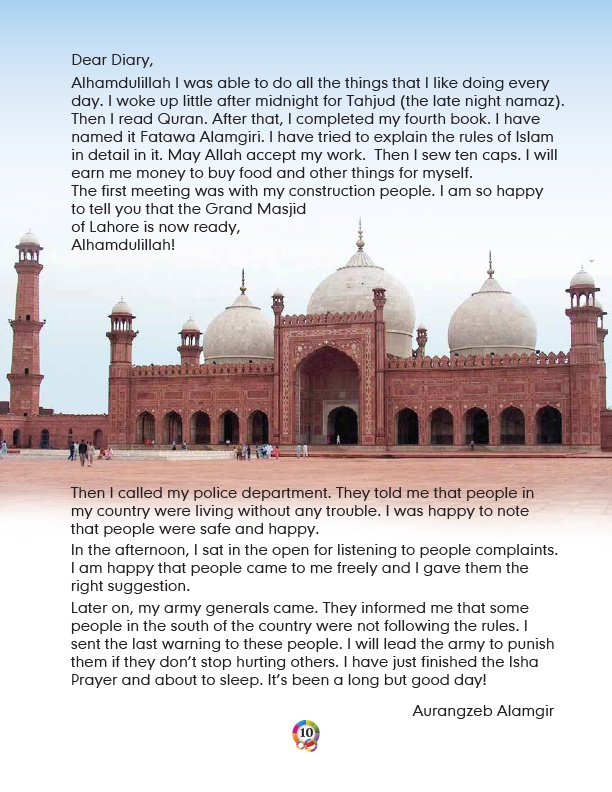
1. Military Hierarchy
Many people may not know this, but Aurangzaib Alamgir was a great military strategist. He was an excellent commander who had the honor of winning every battle he fought. He organized his army from the lower to the higher ranks. Even the British Raj followed the structure left behind by this noble king.
2. Land Reforms
It might sound amazing to many, but the land reforms put in place by Aurangzaib are still in place to a great extent. The three most important things related to land were done by him:
1. Registration
2. Taxes and
3. Transfer
3. Islamic law
He codified the Muslim Hanafi laws into proper categories. The total collection is spread over many volumes, and this material is still in use by Muslim scholars. As a matter of fact, you can find his Fatawa Alamgiri in most Muslim Hanifi Madrassa of the Indian subcontinent.
4. Peace on Land
Most historians agree that he was the greatest empire ever to exist in this part of the world, both in terms of GNP and land. Yet, there was peace in most parts of his vast empire. Police were vigilant, while justice was swift and within reach of the masses.
Even one of these achievements could have won any leader a place in the hall of fame of the great leaders. With Aurangzaib, unfortunately, the opinion is exactly the opposite. He is regarded as a cruel, barbarian, and unorganized person. The intentions behind this campaign to vilify Aurangzaib are beyond the scope of this article. What is more important to mention here is the fact that our children need Auragzaib, now more than ever. The reason is obvious: our children need to learn how to be good planners and organizers. They need to look up to a person who has these two skills, but that someone has to be one of their own. Aurangzaib Alamgir is that person.
Long after children have forgotten all the facts and figures given in a social studies syllabus, what will remain with them will be the skill of planning and organization, something they had learned trying to imitate one of their own – Auragzaib Alamgir.
EAST’s butterfly and Friends social studies syllabus have a complete chapter on Auragzaib Alamgir. Look for the complete class three social studies book in the books section of this website.