Butterfly & Friends English language course with thematic English stories for kids learning English uses eight popular themes.
Children have a natural ability to learn a language if it’s taught in an interesting manner. Children learn a language quickly when a language is connected and has a practical purpose. Children acquire language rapidly if it’s related to interesting events and places. The interrelated sentences are easy to understand compared to sentences taught in isolation. That’s why children learn a language quickly when they watch movies.
Don’t be afraid of the word themes. When working with children, themes are nothing more than a natural way of learning. So what are themes? They are topics around which various activities are organized. In a way, a theme is a backbone to which all the other language components are attached, like body parts.
Let’s be more specific. The theme helps bond all the listening, speaking, reading, and writing activities together. With the help of themes, children will listen, speak, read, and then write around the same topic.
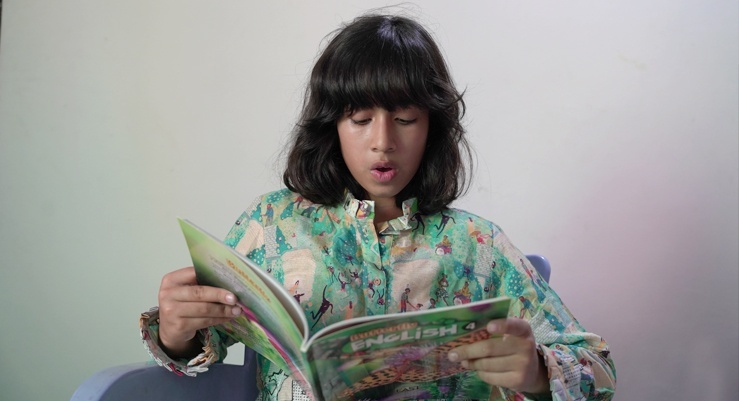
What’s the benefit? There are many. First, it helps in the repetition of English vocabulary.
With the help of a theme, you can group the similar words together and then repeat them throughout the course of that theme. This will help children to listen to those words over and over again. That type of repetition is important when you want children to start using a set of words in their English speaking and writing.
Secondly, a theme helps children to learn how to look at a subject or situation in many aspects. That helps them in observing a situation more deeply and from various angles.
So what are the different components of language development that can be associated with a theme? We have already mentioned that the four components of language development, listening, speaking, reading, and writing, can be arranged around a theme nicely.
Children have to do plenty of listening and speaking of common or most frequently used English vocabulary to construct a sentence. Then they have to recognize the same words when shown in writing. That helps them to read a small amount of text and starts the development of reading skills. At last comes creative writing that is done with the help of words that children have already learned to speak and read.
Now, with this perspective in mind, let’s look at the makeup of Butterfly and Friends English Workbook Series Pre-year 3. This wordbook comprises eight themes especially selected for young children. These themes are:
1. My environment
2. Body parts and the sense
3. Festival (Eid)
4. Animals and their homes
5. Transport
6. People who help us
7. Seasons
8. Tools
Each theme has the following components:
1. Sentence starters and prepositions
2. Common words
3. Action words
4. Opposites
5. Spatial
6. General knowledge or thematic vocabulary
7. Reading
8. Reading comprehension
9. Creative writing
The first six of these nine components consist of the essential vocabulary necessary to learn English. These are 243 words organized under the first six components mentioned above. In Butterfly and Friends, these common words are further divided according to the specific theme. Here is how these 243 words are divided according to the themes:
Theme 1: My Environment contains 24 words
Theme 2: Body parts and senses contains 24 words
Theme 3: Festival (Eid) contains 34 words
Theme 4: Animals and their homes contains 31 words
Theme 5: Transport contains 31 words
Theme 6: People who help us contain 34 words
Theme 7: Seasons contains 36 words
Theme 8: Tools contains 29 words
Each set of words is carefully related to the theme. There are listening and speaking activities for all these words in that section of the theme.
Once children learn to listen and speak these words comes the reading. This reading is a story based on the theme introduced at the beginning of that section. That provides children with a reading practice of the words they have already listened to and spoken.
Then come the questions and answers part of the theme. These questions are around the thematic story children have just read and enjoyed. The questions require the answer of one sentence, again using the same vocabulary given at the beginning of that section.
Writing these one-sentence answers prepares children for the last activity: creative writing. Once again, the creative writing is done around the theme using the vocabulary already practiced by children.
This same scheme of language development is used for all the eight themes given in the workbook. This type of language development strategy helps children to acquire new vocabulary at a rapid pace. It makes them use the vocabulary more frequently and leads to the most important of all the language activities: creative writing.
How useful was this post?
Click on a star to rate it!
Average rating 0 / 5. Vote count: 0
No votes so far! Be the first to rate this post.