Here are some more benefits of short stories in the B&F Series. You may download the B&F series in pdf format to read all these stories.
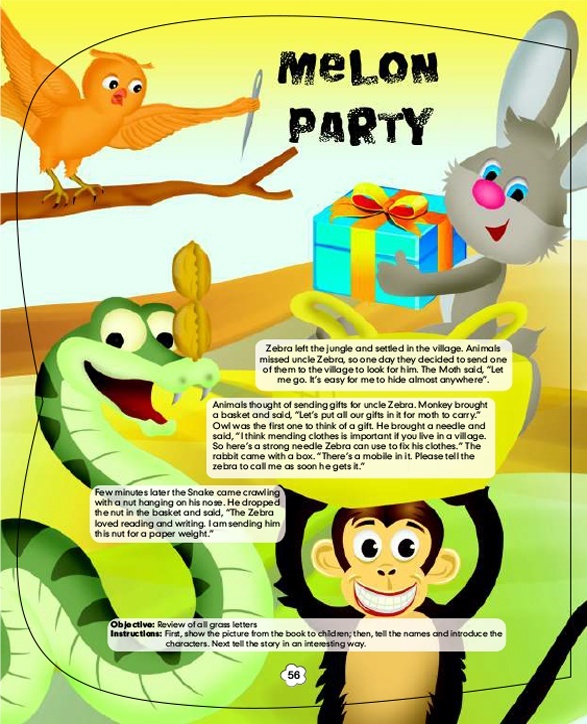
Melon Party
If we have no peace, it is because we have forgotten that we belong to each other. Mother Teresa’s Solidarity or brotherhood (Arabic: Assabiyah, Akhowah) is what holds a nation together. Without unity, a nation cannot progress regardless of all the natural resources it may possess.
The fourth story of Butterfly and Friends English series – Melon Party – is about belonging to each other. This story is symbolic and needs some explanation.
They have strong bondage; society must accept its members with all their different cultural and linguistic backgrounds. To have peace and prosperity, people should accept the ethnic, social, and religious beliefs of others around them.
The tall, fair-skinned individual with a large turban should care for the dark-skinned man wearing a coat and tie and vice versa. They should take care of at least five basic needs of each other:
1. Food
2. Need for companionship
3. Shelter
4. Clothing
5. Education
Melon Party has these five basic needs and various types of individuals that make up a society represented in it. Let’s list all the symbols highlighted in this story:
Symbol | Meaning |
The jungle | Country, Society |
Animals | Members of society |
Moth | The weak |
Monkey | The idea person |
Owl | The thinker |
Rabbit | The worker |
Snake | The humble |
Zebra | The adventurer |
Alligator | The powerful |
Needle | For clothing |
Mobile | For keeping in touch |
Nut | For learning |
Melon | For food |
Village | Safe heaven, shelter |
The jungle animals are different from each other in the way they walk, eat and live. But they are together. You will not see the animals criticizing Zebra (who left the jungle out of fear of the wolf). They haven’t forgotten Zebra and would like to express their love for him. That’s where the gifts come in. As the above list shows, each gift is to provide for a specific need of their long-gone friend.
Here are some questions you can ask children at the end of the story:
● Name the animals mentioned in these short stories.
● What’s common between all these animals?
● Why did they miss Zebra?
● Do you think they are happy living together?
● What keeps them happy living together?
● Explain the basic needs (1. Food, 2. Need for companionship, 3. Shelter, 4. Clothing, and 5. Education.). Then ask. What would happen to you if you don’t get proper: 1 Food, 2. Need for companionship, 3. Shelter, 4. Clothing and 5. Education?
Playing Ball
There are two important lessons for children to learn from these short stories.
Understanding others
The Fox is interested in finding a playmate. He is not bothered about the needs of the Frog. This story helps children understand life from others’ points of view.
● What was Fox interested in doing?
● What Frog wants to do instead?
● What would you do if you wanted to play, but your friend didn’t?
Thinking of Alternatives
The three friends go around looking for a ball to play with. They couldn’t find one. Their friends offer them things other than a ball. Kitten comes up with the right alternative to a ball – a tomato! This teaches children to think of alternatives, which is an important life skill.
● Who was looking for something to eat?
● Who wanted to play?
● Who gave them a tomato?
● What would you do if you didn’t have: a pencil to write with, a pair of shoes to wear, a bag to carry your books and copies, paper to write on?
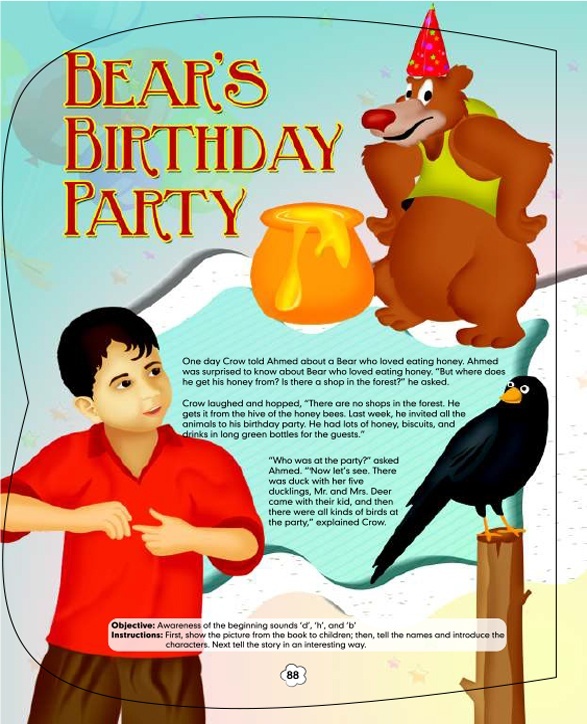
Bear’s Birthday Party
Ahmed has a birthday party coming up. He would like to invite the animals living in the forest to his party. For that, he requests Crow to go to a jungle and invite the animals.
This story is about meeting people not living in your neighborhood. Children should enjoy meeting new people. “People who don’t look like us or we hardly know can also be invited to a party,” is the idea behind this story. This will help children create a wider circle of friends and acquaintances.
● Who was invited to bear’s Birthday party?
● What food did bear offer to his guests?
● Who would you like to invite to your birthday party?
● What kind of food will you offer to your guest?
Nine Ducklings
This story is about hiding and seeking play at Ahmed’s birthday party. Here are the ideas incorporated in this short story.
Spatial concepts
Four important spatial concepts are incorporated into this story. These are: among, inside, behind, under. Through this story, children understand these four basic positions.
Counting
Children learn to count up to number nine.
Creative thinking
Each animal tries to find a suitable hiding place. A frog hides inside the mud because it has the same color as his skin. This is called camouflage, something that most animals do. Through this story, children learn to use their creative thinking.
● Where was the parrot hiding and why?
● Let’s try counting up to nine.
● Why did the gorilla decide to hide behind the yacht?
● Where would you hide if you were there?
How useful was this post?
Click on a star to rate it!
Average rating 0 / 5. Vote count: 0
No votes so far! Be the first to rate this post.