Research shows that phonics is one of the best ways to teach children English pronunciation, vocabulary, and reading. Recognition of the beginning sound is the most important skill when it comes to the reading of a word. Some researchers recommend that the review of beginning sounds should be done regularly, basis even up to class three. That’s because: Children can read a word more conveniently if they can recognize the beginning sound.
We all agree: Reading is the most important of all the educational skills. Readers are leaders, is a common and time-tested saying. Without a doubt, the value of reading ability has only increased in the 21st century. But before we make children fluent readers, we have to focus on teaching children pronunciation of alphabets.
Unfortunately, most children don’t properly recognize the beginning sounds at an early stage. Therefore, they always have a problem recognizing it, which turns out to be the basic hurdle towards good reading skills.
There are six steps that must be followed when teaching children how to recognize the beginning sound. Children are unable to learn reading if any of these steps are missed or skipped while teaching it. Each step serves as the stepping stone towards the next step. Sure it takes a little longer than the old method, but it pays off in the long run. The old method is ineffective as some studies show that children tend to forget the beginning sounds when taught through the old method.
By using this method, we can develop English Pronunciation and English Vocabulary for preschool children more effectively.
A clarification is required at this point. Children might be able to say or sing the beginning sounds in a sequence. But what is needed is actually ‘sound to shape’ recognition. Children should be able to recall the sound when they see the letter at the beginning of the word. That’s exactly what they can’t do properly when taught through the old method.
Here are the six steps of the proper method of teaching the beginning sounds:
1. Vocabulary through Stories
2. The conversation around English vocabulary
3. Introduction of the beginning sound of the vocabulary words
4. Showing off the letter of the sound introduced
5. Rhyme for the letter shape and sound
6. Workbook or Worksheet Activity
Now let’s discuss each step in more detail, and then we will discover how this method is more effective than the old method.
1. English Vocabulary thru Stories
A story written in controlled vocabulary is told to the children. A controlled vocabulary is selected vocabulary around a particular beginning sound. For example, to introduce the beginning sound ‘c,’ we will be telling a story about a calf, cow, crow, cabbage, cake, etc.
Children love listening to stories. By introducing vocabulary through a story, we make learning more interesting. You can tell a story many times without boring the children at all. And by such stories, the listening skill of a child is also developed side by side. The English language of children can also be improved in this way.
There’s no material making or audiovisual aids required. Just open the book or make one yourself and start telling the story to children.
2. Conversation around vocabulary
Next is the conversation. You ask questions about the story. But there’s a trick to that. The answers to your questions should contain the vocabulary words used in the story. In this way, children get a chance to speak the targeted vocabulary after listening to it. For example: Who is the mother of the calf? Cow. What was the name of the blackbird? Crow. What did Ahmed’s father bring for his birthday? A cake.
3. Introduction of the beginning sound of the vocabulary words
Now we gradually lead towards the formal introduction of the beginning sound. So we simply repeat the keywords from the story. We say, “cow, calf, cake, crow. Do you know the beginning sound of these words? ‘c.’ All these words start with ‘c.’ C cow, c calf, c cake.”
4. Introduction of the beginning sound of the vocabulary words
Now it’s time to show the letter. This is the first time we show the letter of the sound to children. Say, “Would you like to see ‘c’? Okay, then here it is.” You can either draw ‘c’ on the board or use a flashcard for this purpose.
5. Rhyme around the letter
After showing the letter and before taking children to the worksheet or workbook for writing practice, introduce a rhyme to help children memorize the formation of the letter. Sing the rhyme repeatedly. Have children trace the letter: a. in the air, b. on the table, and c. their skin, with their two fingers while singing the rhyme.
6. Workbook or Worksheet Activity
Finally, it’s time for the writing practice, so provide children with a worksheet with the letter ‘c’ and a picture of words starting with this letter and let children color and trace.
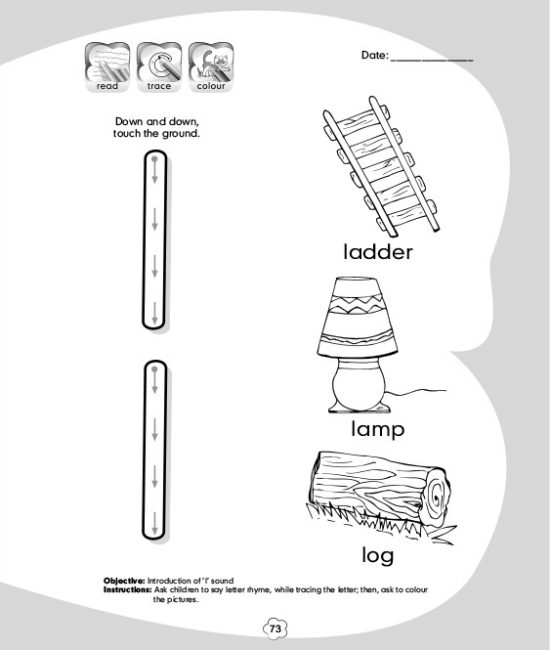
This is the six-step method that helps children learn sounds more effectively. As we mentioned previously, this method is different from the old method. The old method had three steps missing, which are:
1. Vocabulary through Stories,
2. The conversation around the vocabulary of the story, and 6. Proper rhyme.
Due to this, children didn’t get a good knowledge of the vocabulary. They didn’t talk much about this vocabulary. The formation was difficult for children since a proper rhyme was missing.
You will find this “six-step method” of teaching the beginning sounds in the Butterfly and Friends Series. This method is more effective in teaching preschool children English Pronunciation and English Vocabulary for better reading skills.
How useful was this post?
Click on a star to rate it!
Average rating 0 / 5. Vote count: 0
No votes so far! Be the first to rate this post.